
Project Management Software - Page 30
Project Management software automates the assignment of projects and tasks, resource allocation and milestone tracking for all phases of a project. The best project management systems and tools may take one of several approaches: team collaboration, when multiple team members work on a project; top-down, when one person works on a project at a time; or integrated, when multiple aspects of the organization are involved. There are a variety of project management systems and tools that have been designed to fit your project needs, such as Gantt charts and other project planners. Project Management software is related to Professional Services Automation software, Time and Expense software, Web Collaboration software and Workforce Management software. Find the best project management software in Canada for your organization. Read more Read less


Features
- Milestone Tracking
- Time & Expense Tracking
- Issue Management
- Billing & Invoicing
- Gantt/Timeline View
- Kanban Board
- File Sharing Software
- Prioritization
- Resource Management Software
- Budget Management
- Document Management Software
- Multiple Projects

Features
- Milestone Tracking
- Time & Expense Tracking
- Issue Management
- Billing & Invoicing
- Gantt/Timeline View
- Kanban Board
- File Sharing Software
- Prioritization
- Resource Management Software
- Budget Management
- Document Management Software
- Multiple Projects
Local product

Project KickStart
Local product
Features
- Milestone Tracking
- Time & Expense Tracking
- Issue Management
- Billing & Invoicing
- Gantt/Timeline View
- Kanban Board
- File Sharing Software
- Prioritization
- Resource Management Software
- Budget Management
- Document Management Software
- Multiple Projects

Features
- Milestone Tracking
- Time & Expense Tracking
- Issue Management
- Billing & Invoicing
- Gantt/Timeline View
- Kanban Board
- File Sharing Software
- Prioritization
- Resource Management Software
- Budget Management
- Document Management Software
- Multiple Projects

Features
- Milestone Tracking
- Time & Expense Tracking
- Issue Management
- Billing & Invoicing
- Gantt/Timeline View
- Kanban Board
- File Sharing Software
- Prioritization
- Resource Management Software
- Budget Management
- Document Management Software
- Multiple Projects
Features
- Milestone Tracking
- Time & Expense Tracking
- Issue Management
- Billing & Invoicing
- Gantt/Timeline View
- Kanban Board
- File Sharing Software
- Prioritization
- Resource Management Software
- Budget Management
- Document Management Software
- Multiple Projects

Features
- Milestone Tracking
- Time & Expense Tracking
- Issue Management
- Billing & Invoicing
- Gantt/Timeline View
- Kanban Board
- File Sharing Software
- Prioritization
- Resource Management Software
- Budget Management
- Document Management Software
- Multiple Projects

Features
- Milestone Tracking
- Time & Expense Tracking
- Issue Management
- Billing & Invoicing
- Gantt/Timeline View
- Kanban Board
- File Sharing Software
- Prioritization
- Resource Management Software
- Budget Management
- Document Management Software
- Multiple Projects

Features
- Milestone Tracking
- Time & Expense Tracking
- Issue Management
- Billing & Invoicing
- Gantt/Timeline View
- Kanban Board
- File Sharing Software
- Prioritization
- Resource Management Software
- Budget Management
- Document Management Software
- Multiple Projects

Features
- Milestone Tracking
- Time & Expense Tracking
- Issue Management
- Billing & Invoicing
- Gantt/Timeline View
- Kanban Board
- File Sharing Software
- Prioritization
- Resource Management Software
- Budget Management
- Document Management Software
- Multiple Projects

Features
- Milestone Tracking
- Time & Expense Tracking
- Issue Management
- Billing & Invoicing
- Gantt/Timeline View
- Kanban Board
- File Sharing Software
- Prioritization
- Resource Management Software
- Budget Management
- Document Management Software
- Multiple Projects
Local product

SystemX
Local product
Features
- Milestone Tracking
- Time & Expense Tracking
- Issue Management
- Billing & Invoicing
- Gantt/Timeline View
- Kanban Board
- File Sharing Software
- Prioritization
- Resource Management Software
- Budget Management
- Document Management Software
- Multiple Projects
Local product

AITable
Local product
Features
- Milestone Tracking
- Time & Expense Tracking
- Issue Management
- Billing & Invoicing
- Gantt/Timeline View
- Kanban Board
- File Sharing Software
- Prioritization
- Resource Management Software
- Budget Management
- Document Management Software
- Multiple Projects

Features
- Milestone Tracking
- Time & Expense Tracking
- Issue Management
- Billing & Invoicing
- Gantt/Timeline View
- Kanban Board
- File Sharing Software
- Prioritization
- Resource Management Software
- Budget Management
- Document Management Software
- Multiple Projects
Local product

Project Drive
Local product
Features
- Milestone Tracking
- Time & Expense Tracking
- Issue Management
- Billing & Invoicing
- Gantt/Timeline View
- Kanban Board
- File Sharing Software
- Prioritization
- Resource Management Software
- Budget Management
- Document Management Software
- Multiple Projects

Features
- Milestone Tracking
- Time & Expense Tracking
- Issue Management
- Billing & Invoicing
- Gantt/Timeline View
- Kanban Board
- File Sharing Software
- Prioritization
- Resource Management Software
- Budget Management
- Document Management Software
- Multiple Projects

Features
- Milestone Tracking
- Time & Expense Tracking
- Issue Management
- Billing & Invoicing
- Gantt/Timeline View
- Kanban Board
- File Sharing Software
- Prioritization
- Resource Management Software
- Budget Management
- Document Management Software
- Multiple Projects

Features
- Milestone Tracking
- Time & Expense Tracking
- Issue Management
- Billing & Invoicing
- Gantt/Timeline View
- Kanban Board
- File Sharing Software
- Prioritization
- Resource Management Software
- Budget Management
- Document Management Software
- Multiple Projects

Features
- Milestone Tracking
- Time & Expense Tracking
- Issue Management
- Billing & Invoicing
- Gantt/Timeline View
- Kanban Board
- File Sharing Software
- Prioritization
- Resource Management Software
- Budget Management
- Document Management Software
- Multiple Projects

Features
- Milestone Tracking
- Time & Expense Tracking
- Issue Management
- Billing & Invoicing
- Gantt/Timeline View
- Kanban Board
- File Sharing Software
- Prioritization
- Resource Management Software
- Budget Management
- Document Management Software
- Multiple Projects

Features
- Milestone Tracking
- Time & Expense Tracking
- Issue Management
- Billing & Invoicing
- Gantt/Timeline View
- Kanban Board
- File Sharing Software
- Prioritization
- Resource Management Software
- Budget Management
- Document Management Software
- Multiple Projects

Features
- Milestone Tracking
- Time & Expense Tracking
- Issue Management
- Billing & Invoicing
- Gantt/Timeline View
- Kanban Board
- File Sharing Software
- Prioritization
- Resource Management Software
- Budget Management
- Document Management Software
- Multiple Projects

Features
- Milestone Tracking
- Time & Expense Tracking
- Issue Management
- Billing & Invoicing
- Gantt/Timeline View
- Kanban Board
- File Sharing Software
- Prioritization
- Resource Management Software
- Budget Management
- Document Management Software
- Multiple Projects

Features
- Milestone Tracking
- Time & Expense Tracking
- Issue Management
- Billing & Invoicing
- Gantt/Timeline View
- Kanban Board
- File Sharing Software
- Prioritization
- Resource Management Software
- Budget Management
- Document Management Software
- Multiple Projects

Features
- Milestone Tracking
- Time & Expense Tracking
- Issue Management
- Billing & Invoicing
- Gantt/Timeline View
- Kanban Board
- File Sharing Software
- Prioritization
- Resource Management Software
- Budget Management
- Document Management Software
- Multiple Projects
Project Management Software Buyers Guide
Table of Contents
Essential project management software buying information
Project management software helps businesses plan, organize, and manage multiple projects, such as marketing campaigns, events, product and software releases, and construction projects. The software provides features to allocate tasks to individual contributors and teams, create project workflows, collaborate with team members, and reporting to track project and task progress.
Project managers and team members are the main users of project management software. This includes unofficial or informal project managers, such as construction managers or marketing agents who are coordinating project work.
Most project management software on the market are priced on a "per month" basis, and their entry-level pricing plans range from $7 to $1,500 (approximately $10 to $2,065 CAD) per month. [1]
First-time buyers should begin evaluating options with a budget, number of users, specific use cases, and necessary integrations in mind. Partner with stakeholders on a list of important questions for vendors to help you evaluate their systems based on your needs, such as:
- Which project management tasks can this system automate?
- How can we use this tool’s dashboards to better visualize and track statuses of projects?
- How does this tool support our project management methodologies (e.g., agile, waterfall, hybrid, etc.)?
- What level of technical support will I need from the project management software provider?
- Does this tool use artificial intelligence to generate status reports and/or enhanced resource planning? If so, how?
Hussain Bandukwala [2], a project management office (PMO) consultant and PM instructor who’s trained more than 100,000 professionals, says a question that “really stumps” many companies is how different licence types within a product work.
“With the advent of software as a service [models], you have different user-based licence types,” he says. “So it’s important to understand what each licence type gives you, plus their cost and limitations.”
What are the most reviewed project management systems?
Our research shows that Notion is among the best rated in the category with 2,584 verified user reviews from the past 2 years. Notion is recognized for its highly customizable page creation, real-time collaboration, cross-platform access, and extensive template library.
These are Notion’s main features:
-
Notes management: Notion users highlight its versatile formatting, easy linking, and multimedia embedding for notes.
-
Knowledge base management: This software offers flexible structure, powerful search, and integration with Google Drive.
-
Project planning/scheduling: Users like Notion’s customizable views, templates, and integrations with Google Calendar, Figma, and Miro.
-
Task editing: Reviewers highlight Notion’s real-time, intuitive task editing with drag-and-drop, custom statuses, and history tracking.
-
Task management: Notion offers flexible, customizable task tracking, Kanban boards, and reminders.
-
Collaboration tools: Users appreciate real-time editing, easy sharing, and permission controls.
What is project management software?
Project management software is a system designed to automate task assignment, resource allocation, and milestone tracking for all phases of a project. It helps create, assign, and track project work with features such as task management, project status report generation, budget tracking, and timeline tracking. Project management tools also help optimize resource allocation by generating reports that identify resource overloads, imbalances, and availability constraints.
Project management software is related to the more robust project portfolio management software, as well as the more general-use tools including collaboration software and task management software.
Gartner reports that over 85% of businesses actively use project management software and the market is expected to reach a valuation of $7 million by 2026. [3]
On Capterra, you’ll find 1,764 different project management products and 23,021 user reviews for these products have been added since September 2023 alone. [4]
Project management software pricing
Project management software typically follows a subscription model, billed monthly. For those starting out, entry-level plans are generally available around $200 (approximately $275 CAD) per month, offering essential tools such as task management, project planning and scheduling, tracking, and collaboration capabilities.
For more robust needs, advanced plans are available at approximately $1,400 (approximately $1,928 CAD) per month. In addition to foundational features, these plans offer enhanced functionalities like advanced analytics, custom integration capabilities, and prioritized customer support, designed to cater to more complex project demands.
Over the past two years, our advisors have found that 57% of project management software buyers are setting their budgets within the range of $20 to $40 (approximately $28 to $55 CAD) per month. [5]
For first-time buyers, initial expenses often include implementation, data migration, and customization costs, while ongoing expenditures typically cover maintenance and support services. These factors are crucial to consider for a comprehensive understanding of the total cost of ownership.
Project management software features rated by users
All project management software tools include task management, project planning/scheduling, and reporting/project tracking features. And most systems share a variety of common features such as prioritization, billing and invoicing, and managing multiple projects.
Core project management software features
-
Task management: Create tasks, track progress status and completion percentage and view any associated notes or comments. 91% rate this feature as critical or highly important.
-
Project planning and scheduling: Create project plans, define project objectives, set milestones, and establish project timelines. 91% rate this feature as critical or highly important.
-
Reporting/project tracking: Generate various reports and performance metrics to track progress, analyze data, and gain insights into project health and team performance. 84% rate this feature as critical or highly important.
-
Collaboration tools: Provides a channel for team members to share media files, communicate, and work together. 80% rate this feature as critical or highly important.
Highly rated common project management software features
-
Multiple projects: Ability to track and manage several projects simultaneously. 90% rate this feature as critical or highly important.
-
Prioritization: Arrange activities and tasks based on their relative importance or urgency to complete. 85% rate this feature as critical or highly important.
-
File sharing: Public or private sharing of digital files of various formats such as documents, audio/video, images and more. 80% rate this feature as critical or highly important.
-
Access controls and permissions: Define levels of authorization for access to specific files or systems. 79% rate this feature as critical or highly important.
-
Billing and invoicing: Create, manage, and send invoices or bills to customers. 67% rate this feature as critical or highly important.
Buyers should keep in mind that just because one product has more features than another, it doesn’t make it better for your business. Focus on how well a given system performs the key functions your team will use it for rather than putting too much value on bonus features that may not make a big difference for your business.
“If you don’t know what you are looking for in project management software, any software will look appealing to you,” notes Bandukwala. “That’s why understanding your own requirements is key. As the saying goes: if you don’t know where you’re going, any road will take you there.”
Top project management software benefits identified by users
Enhanced collaborative workspace: Enhances team interaction and collaboration through a unified platform that supports file sharing, real-time communication, and collective problem-solving, applicable in both remote and in-office settings.
“I love the team and collaborative workspace it allows for so that you can truly work remotely as an operational and efficient team.”
–Amanda H., business strategist, marketing and advertising
Precision task management: Provides robust tools to meticulously organize and track tasks against critical project metrics like timelines, budgets, and scope, ensuring each team member has clear directives and responsibilities.
“Without this tool we would not have been able to properly organize all of the steps and milestones, and undoubtedly would not have had such success with each project we completed.”
–Mike H., CIO, education management
Consolidated project insights: Consolidates all project-related documentation and communications into a single, continuously updated hub, making it simple to retrieve historical data and stay informed about current project statuses.
“I love that you can have task/project-related convos and attachments. This is excellent if you are like me and frequently need to show people where they made decisions in the past in an easy way.”
–Michelle M., manager, non-profit
Workflow automation for peak efficiency: Streamlines the flow of project tasks and information by enforcing business process rules automatically to minimize oversights and boost efficiency.
“In order to save time and cut down on mistakes, we have developed our own workflows, implemented reminders, and totally automated repetitive chores. We have achieved greater productivity and a more solid foundation for our performance processes.”
–Christian P., HR manager; health, wellness, and fitness
Amidst these core benefits, the integration of Generative AI has introduced a new layer of sophistication to these systems. In fact, 89% of Canadian project managers say they’re more likely to pursue project management tools that include specific AI features. [7] This technological advancement has notably amplified the capability for detailed scenario planning, a feature that was already integral but is now becoming a standout aspect due to AI's influence.
Bandukwala explains: "Scenario planning for project portfolio management has already been in play, but the whole advent of Gen AI has really thrust everything into popularity, and made way for many new features to help users manage projects more effectively and efficiently." This evolution marks a significant shift in how project management tools are perceived and utilized, highlighting their increasing importance in strategic business functions.
Common challenges of project management software identified by users
Canadian project managers cite budget constraints (51%), collaboration across teams (32%), and challenges in prioritization (30%) as the top difficulties they expect in the next year. [7]
Navigating the landscape of project management software involves overcoming specific hurdles that can make or break the success of its implementation. It's crucial to understand the user-specific issues that arise when deploying these tools. We've delved into user reviews from the past year to pinpoint common challenges faced by users, outlined below.
- Cost concerns: Balancing the budget against the need for advanced features can be tricky. High costs can deter initial investment, especially for smaller teams or startups.
Ask your vendor: What is included in the base price, and how do additional features affect the overall cost? Can you provide transparency on pricing tiers?
Overcome the challenge: Investigate options that offer scalable solutions—where you can start with basic features and add more as your budget allows.
- Complex user experience: An intricate interface can deter users from fully engaging with the software, limiting its effectiveness and reducing overall user satisfaction.
Ask your vendor: Can you describe the design philosophy behind your user interface? What steps have you taken to ensure the interface is intuitive?
Overcome the challenge: Opt for software that prioritizes a clean, intuitive user interface. Evaluate the software through a trial period to ensure it meets the needs of your team’s workflow and enhances usability.
- Steep learning curve: New software can be daunting to learn, especially for teams accustomed to different processes. A steep learning curve can slow down adoption and reduce overall efficiency.
Ask your vendor: What training and support services do you offer to new users? How do you simplify the learning process for diverse teams?
Overcome the challenge: Choose software that not only provides comprehensive training materials like tutorials and webinars but also offers ongoing support.
While these challenges are significant, it's also important to recognize the potential benefits that come with successful implementation.
For example, Bandukwala describes the potential risks and rewards of adopting AI and AI-related features in project management tools:
"There's excitement because there are so many possibilities—acceleration of pace, automation, suggestions, predictions,” he says. “But there are also natural apprehensions around potential roadblocks, such as integration issues, data quality, and ethical concerns."
What is project management software used for?
Analysis of our extensive project management software reviews highlight the most common use cases:
-
Coordinating tasks across project teams: Businesses use project management tools to assign and track tasks at the individual and project level.
-
Managing multiple projects: Project management software users can create and manage multiple projects within one tool, allowing individuals to see their tasks as assigned by due date or project.
-
Optimizing resource management: Project managers are able to assign team members to projects and tasks based on their availability, skillset, and business need.
-
Analyzing and tracking project status: Project management software users can view dashboards and generate reports at the individual, project, and, with some tools, program/portfolio level.
-
Improving communication and collaboration: Teams and clients can communicate using built-in messaging and file sharing. The tool can send notifications to individuals, reducing reliance on email and enabling efficient collaboration, even for geographically dispersed teams.
Many project management software systems are designed to support specific methodologies and/or industries:
- IT project management software
- Project portfolio management software (typically designed for larger corporations and enterprises)
- Agile project management software
- Web-based project management software
Who uses project management software?
Project management software is widely adopted by a variety of professionals who rely on its robust capabilities to manage and streamline work tasks efficiently. Key users include marketing and sales teams, IT departments, construction managers, and personnel within non-profit organizations, each leveraging the software to suit their specific needs.
How different professions use project management software:
-
Marketing and sales teams: They harness project management software to organize campaigns, monitor progress towards sales targets, and manage interactions with prospects and customers.
-
Information technology departments: These professionals use project management tools to manage software development projects, track updates, and maintain compliance with technical standards.
-
Construction managers: They use the software to schedule work, control budgets, and coordinate communication between site managers and subcontractors.
-
Non-profit organizations: Staff in these organizations apply the tools to manage fundraising events, coordinate volunteer schedules, and track grant application processes.
An analysis of more than 2,084 advisory calls conducted by Capterra’s advisors with project management software buyers since September 2023 reveals that 62% of users come from small businesses with fewer than 100 employees and about 65% of these businesses generate less than $25 million in annual revenues–affirming that project management software supports business operations across various sectors and company sizes. [5]
Common project management software integrations
Nearly half (47%) of Canadian businesses say project management software purchases in the past year were triggered by their desire to improve software integrations. [6] We analyzed our extensive reviews database and determined that the three categories most often integrated with project management systems are time clock, CRM (Customer Relationship Management), and task management. These integrations are crucial for enhancing the functionality and efficiency of project management software:
-
Time clock: Allows for accurate time logging on tasks, which is essential for budget tracking, payroll, and assessing productivity. This integration helps ensure that project timelines are adhered to and labor costs are monitored closely.
-
CRM: By connecting CRM systems with project management tools, businesses can streamline the flow of information between sales and project teams. This ensures that customer data and interactions are up-to-date and accessible.
-
Task management: Allows for a more granular level of control over individual tasks and subtasks. This aids in distributing work evenly, setting clear expectations, and tracking progress, which collectively improve project outcomes.
These integrations not only bring data and processes together but also provide a unified view of operations, which can significantly enhance project efficiency and effectiveness.
Recent trends in project management software
Evolving project management with AI: Canadian project managers believe that AI will have the greatest impacts on predictive analytics, task automation, and budget management in the next year. [6] In this research-informed review of AI in project management, Bandukwala joins fellow industry expert and acclaimed author, Peter Taylor, to paint a picture of the now and the revolutionary future in the professional project world, along with the benefits and the challenges of overcoming barriers or resistance to this new world.
The increasing importance of emotional intelligence (EQ) in project management: Over half (53%) of Canadian project managers say they’ve increased their use of EQ as a result of AI adoption. [6] As AI capabilities evolve and mature to handle administrative and technical tasks, the ability to navigate emotions, build strong relationships, and manage conflicts has become increasingly critical.
Sources
-
Capterra software pricing data: Only products with publicly available pricing information and qualified software products within the category as of the production date are included in the pricing analysis. Currency conversions are based on the rate of the day of publication and may differ from current currency rates. Read the complete methodology.
-
Hussain Bandukwala, LinkedIn
-
Software Market Insights: Project Management, Gartner
-
Capterra reviews data: Capterra reviews are collected from verified users for individual software products. For this report, we analyzed reviews from the past year as of the production date. Read the complete methodology. Number of products refers to our complete catalogue.
-
Capterra advisor call notes: Findings are based on data from telephonic conversations that Capterra’s advisor team had with businesses seeking project management software. For this report, we analyzed reviews from the past year as of the production date. Read the complete methodology.
-
and [a]. Capterra Project Management (PM) Software Trends Survey was conducted in July 2025 among 2,545 respondents in Australia (n=240), Brazil (n=227), Canada (n=227), France (n=241), Germany (n=224), India (n=216), Italy (n=227), Mexico (n=236), Spain (n=239), the U.K. (n=237), and the U.S. (n=231). The goal of the study was to understand the PM methodologies and software that companies are using, their benefits and challenges, and the impact of AI on project management. Respondents were screened for full-time employment at companies with more than one employee, working in management-level roles or above. Respondents were also confirmed to be at least partially responsible for PM software purchase decisions and operations within their organization.
Project Management Software Trends


AI and Security Drive Project Management Software Purchases in Canada: Findings from Capterra’s New Survey
AI is transforming what project management (PM) software can do, but it’s also introducing new risks, reshaping buyer priorities, and accelerating decisions, sometimes without enough strategic planning.
Capterra’s latest global survey* reveals how businesses are adapting their PM strategies, how they’re choosing to invest in project management software, and how AI is influencing those decisions. This creates a potentially exciting and precarious moment for Canadian project managers. AI offers speed and scale, but it also brings complexity, security concerns, and uncertainty about how work gets done.
Key takeaways
-
Drive to leverage AI capabilities: Adding AI tech is a trigger for over half of Canadian PM software purchases, and spending is rising accordingly to capitalize on better functionality in software.
-
Security is top priority: 67% rank it as critical when evaluating PM software, and it’s a leading source of both satisfaction and dissatisfaction.
-
Execution challenges persist: Canadians note struggles with integrations and AI adoption and training, slowing value realization.
-
AI is raising the bar for people skills: 53% of Canadian PMs say their use of emotional intelligence has increased due to AI adoption, as automation frees up human capacity.
How is artificial intelligence used in project management software?
AI in project management software is used to predict risks, automate workflows, optimize schedules, and generate content such as summaries or documentation. It spans from narrow tools like predictive analytics engines to embedded features in PM software that automate task assignments or flag risks. But it’s not the same AI that performs all these functions.
Many people think of AI as chatbots or large language models (LLMs), but that’s just one branch focused on generating human-like text. AI also includes systems for advanced workflow automation, designed for different tasks beyond text generation. Together, they help teams manage complexity, reduce manual work, and make data-driven decisions.
Here’s a short overview of the main types of AI used in project management.
| Type of AI for project managers | What it does | Common use in PM software | Where it resides |
|---|---|---|---|
| Large language models (LLMs) | Generate human-like text | Drafting documentation, summarizing meetings, answering questions | Can be standalone, like PMI’s Infinity, integrated into a PM platform, or offered via plugins |
| Predictive analytics | Forecast outcomes based on historical data via machine learning | Risk prediction, delay forecasting, resource planning | Typically integrated into the PM tools’ dashboards or reporting modules |
| Automation engines | Trigger actions based on rules or patterns | Task assignment, workflow routing, status updates | Usually built into the PM system’s workflow engine |
| Machine learning algorithms | Learn from data to improve over time | Identifying patterns, surfacing blockers, optimizing schedules | May be embedded in a PM tool or offered as a standalone analytics service |
Not all AI is created equal, and not all AI is transparent in what it can and can’t do accurately. Buyers should ask vendors what kind of AI is being used, how it works, and whether it’s explainable or a black box. Understanding the difference helps teams choose tools that truly support their workflows and decision-making.
When considering these options, PMs can especially benefit from the predictive analytical tools that AI offers. Project management expert Hussain Bandukwala comments, “It (predictive analytics) has the potential to transform project portfolio management by guiding which initiatives yield the strongest ROI and linking those choices directly to benefits realization. That’s a compelling business case when budgets are under pressure.” [1]
AI drives project management software spend and reshapes buyer priorities
AI is now the leading reason businesses invest in new PM software. More than half of buyers in Canada (57%) say adding AI was a trigger for their most recent purchase. But this isn’t about chasing shiny new features. It’s about tackling rising project complexity, resource constraints, and the demand for speed.
Where the money is going
More than half of Canadian businesses are spending more on PM software, often to expand functionality, respond to price increases, and adopt new systems entirely. On the other hand, less than a third of all businesses increasing their spending put the extra money towards user growth, switching to a more expensive competitor, or adding support services to their current package.
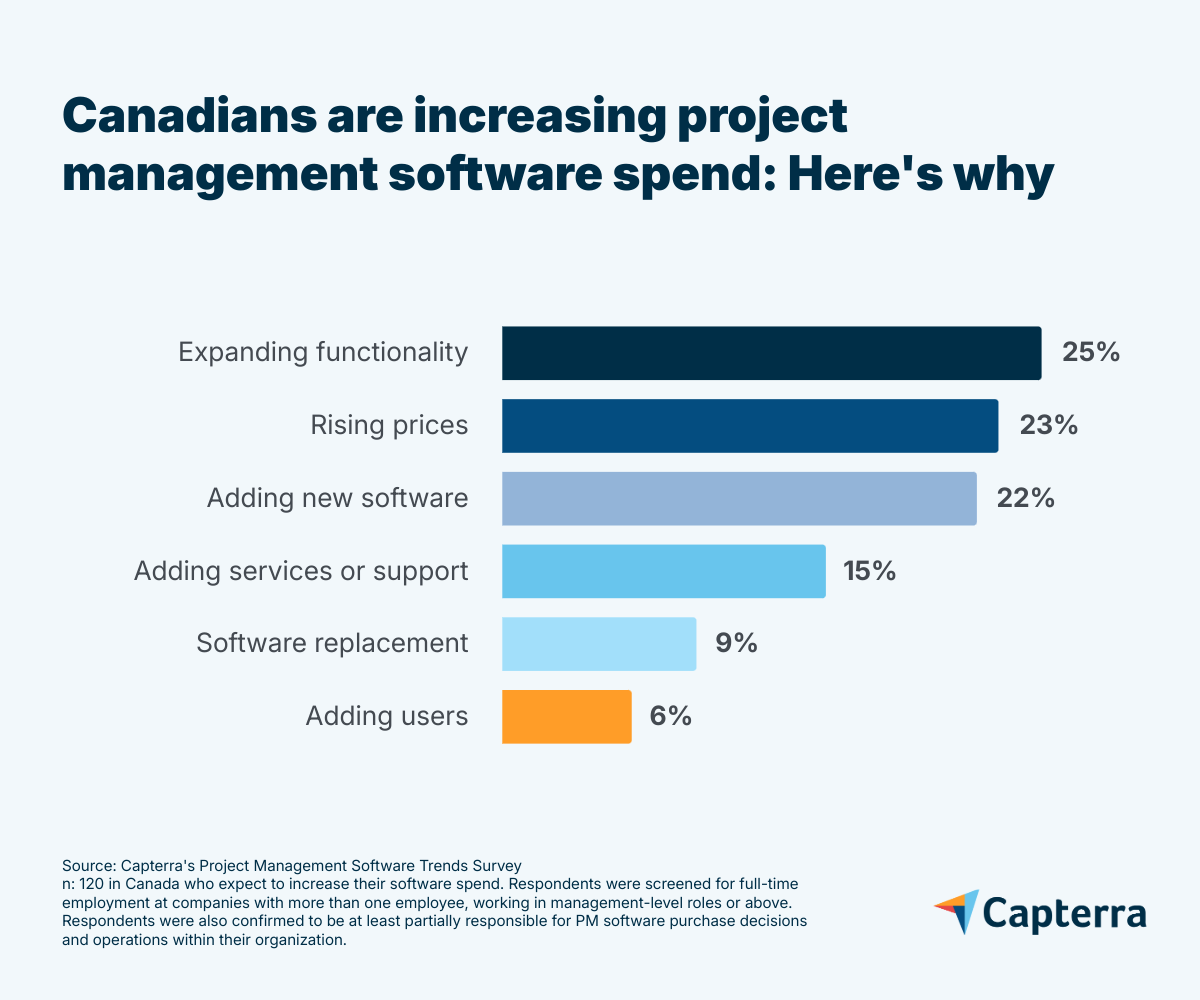
Adding users ranks last, aligning with a widespread move to reduce staffing [2], exacerbated by US tariff uncertainty. Rather than growing teams, businesses are asking current employees to do more with less.
This is especially likely to affect Canadian firms, more than half (51%) of which are highlighting budget constraints as a major issue for the next 12 months, well above global averages and the highest overall worldwide.
“Canadian firms sit in a unique position–heavily dependent on U.S. trade, exposed to tariff swings, and influenced by broader macroeconomic uncertainty,” Bandukwala explains. “Even small shocks ripple quickly, making it harder to commit confidently to financial forecasts.”
For project managers, these factors incentivize the application of AI-powered tools to help manage workloads, compensate for limited staffing, and keep projects on track.
Why it matters
Projects are bigger and more complex. [3] Mega, and even giga, projects (worth US$1 billion or more) span multiple teams, tools, and time zones. Manual coordination with spreadsheets or offline systems isn’t just inefficient, it’s impossible at this scale.
AI is setting expectations. It’s already proving its value in marketing, finance, and customer service. PM leaders are under pressure to follow suit.
Teams are stretched thin. With fewer people and more work, project managers need help reducing admin tasks, surfacing insights, and prioritizing effectively. Bandukwala suggests emphasizing project management ROI in the wake of extra budget scrutiny. “It’s about doing the right things with less, which requires sharper prioritization and better benefits alignment.”
The bigger story is adaptability. Businesses face resource constraints, rising complexity, and pressure for long-term efficiency. AI is seen as the answer for boosting agility despite those challenges and doing more with fewer people, tighter budgets, and faster timelines.
Expert recommendation
Don’t buy into AI buzzwords in marketing. Not all tools will have the capabilities you need and expect. Focus on tools with practical, transparent features. Ask vendors:
-
How does your AI support planning, tracking, and decision-making?
-
How does it integrate with our existing workflows?
The right investment can help teams stay competitive, but only if it’s grounded in real business needs.
AI expansion increases the need for software security
As AI expands software’s functionality, it also increases the attack surface, meaning more data, more integrations, and more risk. That’s why security now outranks functionality and AI features as the top concern at the research stage of selection for project management software buyers.
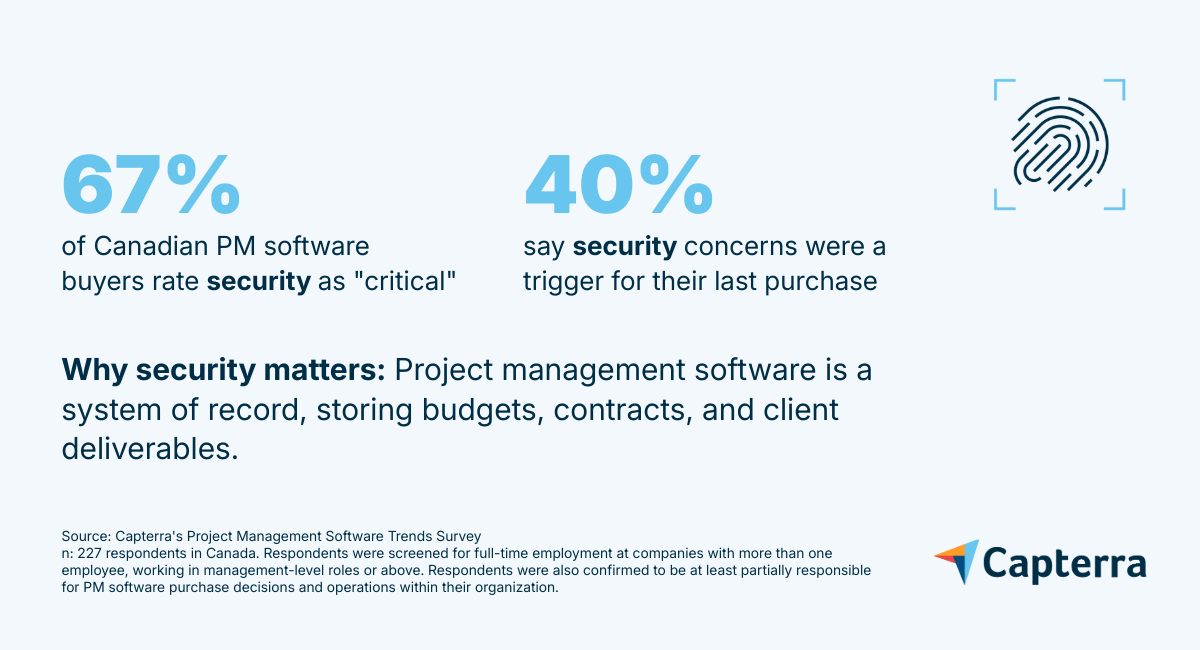
This isn’t surprising: PM software is a system of record that stores sensitive company data such as budgets, contracts, pricing sheets, and client deliverables. And AI adoption raises the stakes further. Generative AI and predictive analytics require ingesting and processing vast amounts of project data, creating new data flows and integration points that attackers can exploit.
Why security is a source of satisfaction and dissatisfaction
Businesses need encryption, access controls, and audit trails. But they also want ease of use. That tension is hard to resolve, and it’s often why security is a major cause of both dissatisfaction and satisfaction for PM software.
Real-world risk: Trello’s 2024 data breach
In July 2024, a hacker known as ‘Emo’ leaked Trello user data on Breach Forums, a well-known cybercrime platform. [4] The data dump revealed the scale of exposure: over 15 million email addresses, along with full names, usernames, profile URLs, board memberships, and account settings. The hacker exploited an insecure API endpoint that allowed unauthenticated users to map email addresses to Trello accounts.
This breach is a stark reminder that project management and collaboration tools are high-value targets for cybercriminals. As PM software becomes more integrated and AI-enhanced, the volume and sensitivity of data flowing through these platforms increases, making weak access controls and poorly secured APIs a major liability.
Expert recommendation
Scrutinize how vendors secure their APIs, monitor for suspicious activity, and protect user identities. Ask:
-
Do AI features introduce new data flows or integrations?
-
If yes, how are those governed and secured?
-
Is an AI specialist required to set up the security features? If so, is one provided?
Security must be a top priority, not just a feature, especially in tools that manage sensitive project and personnel data.
Some teams struggle to make the most of AI-powered tools
Buying AI-powered tools is fairly easy. Realizing their value is the hard part. Forty-one percent of respondents cite AI adoption issues as their top software challenge, driven by skill gaps, poor onboarding of the new system, and workflow misalignment.
Why it matters
This finding aligns with broader adoption patterns we’ve been tracking. AI features require new skills, including interpreting predictions, configuring automations, and adapting workflows. Without proper training, even the most advanced features go unused.
Nearly as many Canadians (37%) report a lack of AI skills on staff, and 42% say integrating new tools into existing workflows is a major hurdle—the highest worldwide. These numbers reflect a deeper issue: Rapid innovation is outpacing Canadian teams’ ability to learn and adapt. And vendors aren’t always helping. Poor onboarding and a lack of contextual guidance leave users underprepared and under-supported.
Effective integration cannot be overlooked when using a project management system. Hussain Bandukwala explains why,
"Seamless integrations create one source of truth, reduce run-around in accessing data, and make reporting instantaneous rather than labor-intensive. It cuts down admin work and accelerates decision making. In other words: poor integration turns software into overhead; strong integration turns it into leverage." - Hussain Bandukwala
To help buyers understand what’s slowing AI value realization, here’s a breakdown of the most common barriers, examples, and what to do about them:
| Barrier to realizing AI value | Example | What to do |
|---|---|---|
| Teams lack the skills to use AI features effectively. AI tools require new competencies like interpreting outputs and configuring automations. | A marketing agency ignored predictive scheduling due to a lack of training, reverting to manual planning. | Build AI literacy with role-based training and scenario-based workshops. Focus on practical use cases like task prediction and risk alerts. |
| Onboarding doesn’t support AI feature adoption. Failure to guide users through setup leaves teams unaware or underprepared on how to use the new capabilities. | A construction firm didn’t train managers on how to set up workflows, so the firm skipped automation and missed chances to focus on higher-value tasks. | Prioritize role-based training for all end users. Pilot with a small team to test usability before full rollout. |
| AI features don’t fit into existing workflows. New tools often require changes to how teams plan, track, and report work, especially when legacy systems are involved. | A healthcare practice’s AI assistant in their new PM tool couldn’t access legacy CRM data, creating duplicate work. | Audit workflows before implementation. Prioritize tools that integrate with your existing stack and involve users early in rollout. |
Expert recommendation
Prioritize products that offer effective onboarding and intuitive design. Build internal training resources to help teams realize AI’s full potential. Ask vendors for role-based training materials and pilot programs.
Using AI tools demands stronger emotional intelligence
AI can generate plans, but it can’t build trust or resolve conflict. That’s why over half (53%) of Canadian PMs say they’ve increased their use of emotional intelligence (EI) since adopting AI.
Why it matters
AI speeds up workflows, but it doesn’t fix misalignment, tension, or communication gaps. These remain the hardest and most human parts of project management.
What is EI?
Emotional intelligence (EI) is the capacity to identify, understand, and regulate your own emotions and those of others to build trust and alignment. EI helps you blend thinking and feeling to make better choices, rather than reacting on autopilot. High-EI project managers resolve conflicts, strengthen relationships, and keep teams aligned.
Key challenges amplified by AI and how EI helps:
-
Training new users (40%) They guide with patience and empathy when AI features feel unfamiliar.
-
Collaboration across teams (32%) High-EI PMs clarify goals, ask deeper questions, and align departments.
-
Managing staffing gaps (22%) They keep teams focused and motivated when resources are stretched.
Expert recommendation
Invest in tools that visualize dependencies, manage stakeholder input, and support cross-team alignment. Just as important, provide training in conflict resolution and strategic communication so PMs can lead effectively in AI-enhanced environments.
AI works for project managers, but only when it’s used properly
Project management software is increasingly less about managing task lists and more about enabling adaptability, efficiency, and responsible AI use. Canadian businesses are investing in tools that help them work smarter, grow faster, and adapt to change with agility.
Buyers expect:
-
Intelligent automation that saves time without sacrificing control
-
Data security to protect sensitive information
-
Easy onboarding for faster adoption
-
Responsible AI that’s transparent and ethical
Interestingly, many teams are also moving away from rigid waterfall or Agile methods toward hybrid approaches. Today, 42% of respondents use hybrid PM methodologies, the most popular choice.
What to watch
-
Responsible AI: Vendors must provide transparency and control, not just automation.
-
Security-first design: Expect more scrutiny of how tools handle sensitive data.
-
Soft skills surge: PMs will need emotional intelligence, negotiation, and strategic thinking to lead in AI-enhanced environments.
-
Workflow adaptability: Tools must support hybrid and custom methodologies.
Final recommendation
Choose tools that support human decision-making, balance innovation with execution readiness, and scale with your business goals. The right PM software doesn’t just manage projects, it empowers people.
Recommended reading
How Canadian companies can combine AI and project management We discuss the key insights project managers need to consider ahead of the adoption of AI tools with Peter Taylor and Hussain Bandukwala.
Three key ways AI-powered software is improving project management This report examines how 200 Canadian project managers are using AI and the benefits they’re seeing.
2025 Tech Trends Report: How to shortlist the right software A guide to shortlisting and assessing software while searching for a new system.
Tech Trends 2025: Mindful of security and ROI, Canadian businesses adopt software to support growth Recent survey findings showing where Canadian business software buyers are prioritizing their growth this year.
*Methodology
Capterra’s Project Management (PM) Software Trends Survey was conducted in July 2025 among 2,545 respondents in Australia (n=240), Brazil (n=227), Canada (n=227), France (n=241), Germany (n=224), India (n=216), Italy (n=227), Mexico (n=236), Spain (n=239), the U.K. (n=237), and the U.S. (n=231). The goal of the study was to understand the PM methodologies and software that companies are using, their benefits and challenges, and the impact of AI on project management. Respondents were screened for full-time employment at companies with more than one employee, working in management-level roles or above. Respondents were also confirmed to be at least partially responsible for PM software purchase decisions and operations within their organization.
Sources
-
Hussain Bandukwala, LinkedIn
-
How many Canadian companies expect layoffs amid Canada-US tariff war?, Canadian HR Reporter
-
Megaprojects: Challenges, Opportunities, and the Role of the Project Profession, The Project Management Institute
-
Trello Data Breach: Hacker Dumps Personal Info of Millions of Users, HackRead